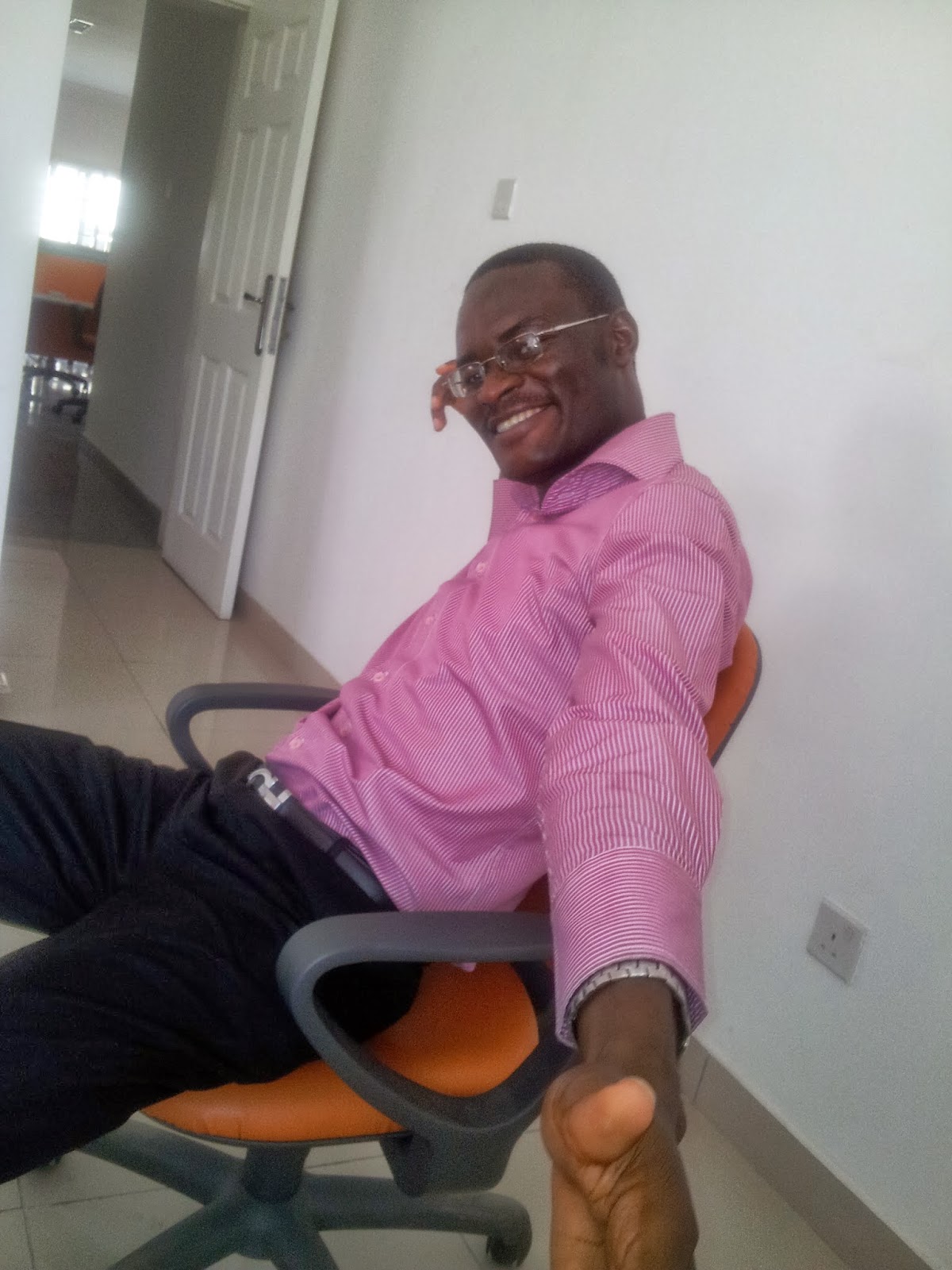
I've got one pleasant weakness -- I hardly give up on anything. And it's a weakness because it's almost involuntary. Once I hold on to a notion or goal, it ends up the other way round: The goal or notion begins to hold on to me, and I become helpless. My mum has stopped trying to influence my decisions only my dad still tries, and it's not because he really expects me to change but as a Medical Lab Scientist he's used to giving advice.

Luckily, it's a weakness with a good side. That's why I call it a pleasant weakness. I have stayed till past 8pm at work and come on weekends on several occasions just because I was working on a problem with no deadline. Yeah, it had no deadline. There was almost zero pressure on me. Yet I couldn't sleep well or spend my Saturdays peacefully without fixing the problem. Why? I somehow made a goal out of fixing it, and then it became on obsession. I'm the computer fix-it guy, Excel guru and a daily blogger because of that weakness. And all the things that are going great in my life benefited immensely from that weakness. 

Through that weakness I stumbled on the reality that to build the best out of anything, give it a lot of time and dedication. Treat it like the seed of a tree; plant it, water it regularly and give it lots of time.

image: jacktoon.blogspot.com

I've got a few friends who take advantage of that weakness of mine. "Michael is going to work himself to death to get it resolved for you. He's just like that."

Though you shouldn't be at the extreme end like me, but once you've found a goal worth pursuing, give it your all.

"Nothing in this world can take the place of persistence. Talent will not: nothing is more common than unsuccessful men with talent. Genius will not; unrewarded genius is almost a proverb. Education will not: the world is full of educated derelicts." -- Calvin Coolidge 

"Genius is one percent inspiration and ninety-nine percent perspiration." -- Thomas A. Edison 

"To see things in the seed, that is genius." Lao Tzu 

Regardless of what trouble and roadblocks you encounter, never give up. Don't just give your best, keep giving it. 


When is he going to propose?
When will the results of the job interview be out? or have some people been contacted?
What does she think about me?
When is he going to pay back the money he borrowed from me?
Why is Junior not as smart as my neighbour's children?
When is he going to ask me out or at least open up about his feelings, rather than telling friends?
When am I going to become rich? (My favourite)
What am I going to write about? (My daily worry)
Why? Why? Why? This is not fair! (Some people's favourite)

image: semannslattery.com

Every week, I experience frustration. And this past week was loaded with it. A writer's block fell on me and almost crushed me. My blog stats are not helping either. It's like driving round a roundabout; you are covering distance but getting no where. Clients aren't responding to my mails. Everybody is back to Lagos and resumed work; the traffic is back too. I couldn't find the blazer I wanted, even after roaming the entire Lekki and VI till 8:30pm. I'm spending more time online reading about other people's frustration, looking for virtual companionship. And now, I'm writing about frustration.

I can link all my frustrations to one simple cause: Expectation. But I can't come up with any way to avoid it. It's part of life. I think it's a symptom of being alive. The more alive you are, the more frustration you'll experience. Because every worthwhile activity you engage in creates an expectation in you. 
You go for a job interview, and boom, you begin to expect a feedback.
You are in love with a charming person, and voila, you expect the charming person to love you back.
You have lots of ideas, and you are expecting them to turn into money.
You are doing your best, and the only thing you want is for everything to be perfect. You feel it should happen because you've worked for it.

Well, I can tell you one thing for sure: Before whatever you expect happens, you'll have to get along with Mr Frustration. Frustration is what happens when reality and expectations are not meeting. And for most regular people, like me, they seldom meet.

But I won't leave you feeling helpless. I want you to know that every time you are frustrated, it is because you are alive and active. And you need to find a way to get along more peaceably with Mr Frustration. I find reading about other frustrated people very comforting. I also find screaming once in a while extremely comforting. And I find drowning my thoughts in work most comforting.


Most of us began life on a boat of superstitions, and have only been switching one boat for another throughout our lives.

Superstition is simply a notion maintained despite evidence to the contrary. 
There's enough evidence showing that the Moon revolves round the Earth, not a person. My sister spent the better part of her childhood believing the Moon was following her every night they were both out. It's a clear example of superstition.

And there are common ones: having a lucky number, being asked for money on a Monday morning (my dad's favourite, I was better off being punished at school for not bringing the money for Home Studies practical than asking my dad for it on a Monday morning), being handed a thing with a left hand, killing a duckling, and so on. 


But in today's post I'll be sharing the wrong things I have been told (and almost made to believe):
  1. There's someone holding my dream job; I just have to find and connect to that person. Actually, it's true. Connections matter a lot in life. People are our doors to greatness: we'll have to pass through them. The only wrong thing about it is the way I was told -- with too much emphasis on meeting the "person". It made me less willing to make my own way. I kept trying to find the "person" rather than being the "person" for myself. I have stopped thinking that way. Now I tell myself: The best helping hands I will ever get are the ones at the end of my arms.
  2. Start charging for all these stuffs you do for people for free. They are right, except that they meant I should charge for everything I could charge for. Microsoft Encarta is dead today and Wikipedia has taken it's place because of that. You can't hoard knowledge. Someone will find it out some other way someday. And you and your knowledge will become useless. Sharing is the only way to become valuable. Charge for only one thing and give every other thing away, freely. Like Google, they give you almost everything for free and charge for very few things.
  3. Marry now, when you are poor, so you won't risk marrying the wrong person when you are rich. It's only right because I don't know if and when I'll become rich, and so might end up over delaying marriage. It's wrong because it is simply marrying for the sake of money, or lack of it.
  4. You have to stand up for yourself or people will always cheat you. It was a very good advice and I'm happy I followed it. But it was incorrect too. Standing up for myself, screaming back at people and going further to stand up for others only made me feel extremely good. It didn't make people not cheat me. The only thing that has saved me from fraudsters was ignoring them. To avoid being cheated, ignore people a lot.
  5. Think about what people will say. It's the one statement that makes me stop thinking. Every time my dad says it (funny, my mum hardly says it), I change the topic. Who are the people? No names; no faces. I don't care about faceless people.
  6. What do you think about John and the new chic he's dating? What do you think about Jonathan and Obasanjo? What do you think about North Korea's nuclear threat? Phew! I've got enough troubles of my own to start thinking about things I have no influence on. Poking one's nose in other people's affair is wrong
And those are the ones I can remember for now. Enjoy your weekend!


Since 2011, I have been a UN online Volunteer. I volunteered for an online open university (PEOI) as a course content developer. But my goal then was to improve my chances of being a UN Volunteer. 


Every year UN selects some 8,000 professionals from about 160 countries for a 6 to 12 months renewable volunteer programme -- United Nations Volunteer (UNV) programme.

And below is a culled details of the UNV programme from UN official website.


To become a UN Volunteer you should have the following values and commitment, and possess the following professional qualifications:

Values and commitment
  • Strong commitment to the values and principles of volunteerism;
  • Ability to work in a multi-cultural environment;
  • Ability to adjust to difficult living conditions;
  • Strong interpersonal and organizational skills;
  • Prior volunteering and/or working experience in a developing country is an asset.
Professional qualifications
  • A university degree or higher technical diploma;
  • Two years of relevant working experience;
  • At least age 25 when taking up an assignment (there is no upper age limit);
  • Good working knowledge in at least one of the three UNV working languages: English, French and Spanish.
United Nations Volunteers is an equal opportunity programme which welcomes applications from qualified professionals. We are committed to achieving diversity in terms of gender, nationality and culture.
Conditions of Service
The key benefit of being a UN Volunteer is the personal satisfaction the volunteer assignment brings to you as you make a positive impact on peace and development. It also leads to a unique enhancement of your professional experience. 
To support you during your assignment, you will receive:
  • Settling-in-Grant calculated on the duration of assignment, which is paid at the beginning of the assignment;
  • Volunteer Living Allowance (VLA) (not a salary) intended to cover basic living expenses, which is paid each month;
  • Travel on appointment and at the end of assignment as applicable;
  • Life, health and permanent disability insurance;
  • Annual leave;
  • Resettlement allowance calculated based on the duration of assignment, which is paid upon satisfactory completion of the assignment.
Note: The above general provisions are summarized from the Conditions of Service for international UN Volunteers.
The vast majority of UNV assignments are based on six to twelve month renewable contracts, with the expectation that the UN Volunteer will serve one year or more.
UNV assignments are exciting and rewarding, but living conditions can be difficult or at times dangerous. Many UN Volunteers work in remote, isolated duty stations and some operations are non-family assignments. We encourage you to read and fully understand the above summary of the Conditions of Service before you continue the application process.
If you are not able to apply to be a UN Volunteer at this time, please go to other volunteer opportunities to find out more about volunteering for peace and development and other ways in which you can make a difference.

If you have read the FAQs and are ready to register, proceed to create your UNV account. 


Luxury expenses are expenses you make on a product or service that is not a necessity. In order words, they are expenses you make on goods and services you can do without. An example is buying Rolex's The Oyster Perpetual Day-Date. The 18k Gold one costs over N5 million.


That's an extreme example. But you'll agree with me that regardless of who you are, a N5 million watch is a luxury. You'll probably need to tell people that it costs that much before they'll even notice. You could buy a good Range Rover Sport 2006 at that price.

Yet Rolex makes about 2,000 watches per day and people buy them. Definitely some billionaires and millionaires, but also some regular guys. For some people that Rolex watch is their ladder to a career upgrade. And that is what I intend to explain in this post -- not all luxury expenses are worth cutting.

I have come across a few guys who are very good at saving. They could save on a minimum wage salary. But they pay for it in ways they do not intend. They are dressed shabbily; they don't eat well; they live like paupers yet they have a fat bank account. And occasionally I wonder: who are they saving for?

Some expenses aren't worth cutting. Don't cut down on the quality of food you eat. Good food also cost much. Meat is not cheap. Fruits are expensive. A balanced diet is an expensive diet. 
Dress well. Wear good shirts, good clothes, good shoes and a good body spray. When it comes to clothing, only cut down on dry-cleaning. Don't start buying cheap.

When you're trying to save more, be careful with expenses that relate to food, clothing and shelter. You could reduce your frequency of eating out and make most of your meals; you could take opportunities of sales discounts and start hand washing your clothes; and you could get your sisters/in-laws to help with house indoor decor rather than paying someone else for it. But never cut down on the quality of food you eat; never cut down on the quality of clothes you wear; and don't live like a fugitive just to save money. 

You will always see people living on less than half of what you live on per month. An evidence that you've got luxury expenses. Examine all your expenses, but remember that all luxury expenses aren't worth cutting. You wouldn't want to look like an 80 year old man at the age of 50. Looking your best, internally (health-wise) and externally (impression-wise), requires a few luxury expenses. 


Throughout my University days I was known as Freeman. One day, my Aunt came visiting and she had to describe me to my room mates before they knew it was me. 

image: mitel.tv

Freedom is not an end to slavery. There's almost no more slavery in the world, yet the clamor for freedom is still strong.
Freedom is not about equal rights and treatment. Or else no one is truly free.
Freedom is not the lack of opposition. Or else the fight for freedom won't be a worthy cause. Any cause that seeks to eliminate all opposition is evil.

Freedom is simply the ability to make my own choices.

Here's the more philosophical part.
The truth is no one can take away that ability from you. They can try to limit your choices, but it's not same as taking away your freedom. Nature is constantly limiting our choices. Every night the sun sets, it takes with it some of our options. Every time the rain falls, we lose some options.
All the great men that fought for freedom, actually fought for something bigger. It was freedom that made great Mandela chose a hard life fighting apartheid, spending over 27 years in prison. It was freedom that made the people of South Africa not lose hope. They showed the rest of the world that the ability to make one's own choices is in-born and no one or system can take it away. They can try hard to limit the range of choices. And we, like the great Mandela did, can chose to make it impossible for them. We lose our freedom only when we decide to not make our choices. It wasn't freedom great Mandela and the South Africans fought for; they didn't lose their ability to make their own choices and it was evidenced by the choice of actions they made. They fought for something much bigger. They fought for their future and their land.
We made umbrellas to get back the options rainfall denied us. We made electricity to get back the options sunset denied us. And it was because we had our freedom intact that we could get back the options we were denied.

The only people that lost their freedom were the slaves in Django who didn't use it. The people who trudge through life with someone else's manual. They don't make their own choices. They are the only ones that have lost their freedom, and it's because they threw it away. No one took it from them. They complain about the rain, the sunset, the politicians, the economy, and being born as a Nigerian. They don't take out an umbrella, they don't switch on the light, they don't use their freedom to fight for their future and their land. They simply complain and trudge on.


Time, my friend, is the one thing Bill Gates, Carlos Slim, Warren Buffett, and Aliko Dangote do not have more than you. Everyone's day has 24 hours, regardless of who you are. 

image: cmich.edu

In today's post I'm going to show you the right way to think about time.

Since Time is universal and equally distributed, I can safely use myself as a case study. 

So here we go. 
I have got a limited amount of Time: safe to say, not more than 100 years. I have spent some already (equal to my age). I don't know how much Time I have left on earth; all I know is that I don't have up to 100 years left. And the worrisome part is I have little influence over how much Time I have left. Beyond avoiding activities and habits, and maybe a place like Lagos, that can make me die young, there is nothing I can do to get all the Time possible (e.g. living up to 100 years old). 
I have got 365 days in a regular year and 366 days in a leap year. I have 24 hours a day. 60 mins in every hour. And I can't change it a bit. I can't add a single hour on top of my year. I've got the same as everyone.

Ok. I have talked about all the things I can't change or influence about the Time I have. Now I'll move on to the things I can change or influence.

If I eat well and live a healthy life, I might end up not spending any of my precious time in a hospital. If I remain cool headed and law abiding (as I perfectly am), I won't have to spend any year locked up in a tiny prison cell. If I'm very careful in choosing my friends and work (ultimately, colleagues too), I will never feel like I have wasted any moment of my precious Time. If I use you my head, I can turn part of my Time to cool cash. And if I live right, I'm sure to get the most of my Time on earth.

So based on the statements above, I believe the following are the right way to view Time:

  1. Time is Life.
  2. William Shakespeare lived for 34 years, and the world is still in awe of him. It's never about the number of years you get, but the use you put them to.
  3. Now is all you have: the past is gone, and today was yesterday's future/tomorrow. Every day you make the most of is not just a day well spent, but a future well spent.
  4. Time is more than money. If you keep exchanging your time for money, you are cheating yourself. There so many things you can do with your time that are priceless, that can't be quantified in Naira. And never make the mistake of thinking Joe spent his time better than Jack because Joe is richer. Mother Theresa spent her time in the best way anybody could or hope to.
  5. If you go to bed very happy and wake up full of energy everyday, then you're spending your time right. The Time you have is yours, and like your money, no one has the right to decide the best way to spend it. Stop comparing yourself to every celebrity your age or trying to live up to someone else's expectations, except you are convinced that it's the best way to spend your Time (Life).
And if you're religious like me, always remember that God owns your Time (Life).


In 2013, I bought 60 books. I mean I paid in cash for 60 books (except a few that sold for $0). And why? The truth is whatever reason I give is an after-thought. When I was purchasing most of those books, I had no grand reason in mind. Whenever I'm less busy at work, I browse through books on Amazon.com, and occasionally, I come across a book I love the title or I see lots of positive reviews on. Then I buy it. And that was how most of the 80 books I bought last year were bought. I ended up buying all sorts of books: Greek myth (Odyssey), personal development books, Excel VBA, Financial Modelling, War, Biographies, Autobiographies, and so on.

But today, I will show the tricks that make reading a pleasure and one you'll be willing to spend and skip meals to enjoy.


image: fraakz.com

And here they are:

  1. Don't give yourself a target. Nothing turns play to work faster than a target. Targets kill the fun in any activity. Ask a banker, if you doubt me.
  2. Read only the books you want to read. And this is my biggest trick. I made sure I didn't bring home any of my University books after graduating. I gave them away and burnt the ones I couldn't give away. I was sick of reading books I didn't enjoy. Books that gave me headaches. And it's one of the two reasons I don't want to do a masters. Now I read only what I want to read, and the pages in it that I want to read. 
  3. Life is not about certifications alone. I know people who wouldn't read a book if it's not going to help them get a certification. Some of the books I have learned the most from were certification textbooks, and I bought and read them without the slightest intention of doing the certification exams. The true joy of reading a book is in reading the book for it's sake, and not because you have to memorize it's content for some exam.
  4. Start small. My love for books started as a child. It took me, maybe, more than 2 years to read my first Shakespeare. And I went on to read several after. I don't read to comprehend everything in the book. I read all books like novels. I don't mark them or go back to previous pages. I read from cover to cover, including foreword and dedication. If I enjoyed the book, I read it again.
  5. Read whenever you can. I don't have special times for reading. I read every time I have the opportunity. On most days, I read for more hours than I sleep.
  6. Make reading fun. I sometimes give myself a treat just so I'll be in a great mood to read. I read in the most comfortable posture I can form, even if it makes me doze off after every 3 pages. In fact, those are the kind of sleep I like best: a sleep that is induced by reading. I don't fight it. It is worth paying for.
And those are the tricks to becoming someone that enjoys reading.


Since I began my Investment and Finance self-study in 2011, I have read lots of books. And they have all helped me, and not just in making sense of the investment world, but also in becoming a better person. The truth is, those books added to my age. They gave the understanding of a much older man. The cool thing about Investment, Economics and Finance is that they show you the core of most of our decisions, because we are always making choices among limited options and resources. Everybody knows that an investment scheme that promises you too much returns, like doubling your money in a short time, is fraudulent. The trouble is that most of us don't know when a lot becomes too much and suspicious, and it's worse when we see friends and family making mouth-watering profits. Only a good grasp of Finance can enable you know when a lot is too much and when a return is unsustainable. We all face traffic jam in Lagos. And lots of us have our own theory of how to beat the traffic. But a good knowledge of Economics will help you make the most of the situation. 

Knowledge of Finance, Economics and Investment will help you to know if you should buy a land and build a house now, or later. It will help you to know what trend is safe to follow and the one that will almost wreck you. And the best part is -- you get to see your predictions, small and big, come to pass. Because there will always be some future realities that will jump at you. Just like when a man on a hill observes loggers felling trees, because of his privileged position on a hill-top, he will be able to predict a lot of things. And that's what sound knowledge of Finance and Economics does you, it places you on a privileged platform, high enough to see what others won't see.

image: china.kylereed.com

So here are the Investment and Finance books I have read:

  1. Economics for Investment Decision Makers: Micro, Macro, and International Economics (CFA Institute Investment Series) by Christopher Piros and Jerald Pinto
  2. The Book of Investing Wisdom by Peter Krass
  3. One Up on Wall Steet by Peter Lynch
  4. Financial Modelling by Simon Benninga
  5. Finance by Ehsan Nikbakht
  6. Berkshire Hathaway Letters to Shareholders by Warren Buffett
  7. Security Analysis: The Classic 1940 Edition by Benjamin Graham
  8. The Warren Buffett Way by Robert Hagstrom
  9. A Random Walk Down Wall Street by Malkiel Burton
  10. The Five Rules for Successful Stock Investing by Pat Dorsey and Joe Mansueto
  11. Too Big to Fail by Andrew Ross Sorkin
  12. Lower Your Taxes by Deaver Brown
  13. Personal Finance by Deaver Brown
  14. Jim Cramer's Real Money by James Cramer
  15. Rule #1 by Phil Town
  16. Corporate Finance by Ivo Welch
  17. How to Build a Financial Model by Sol Hong
The funny thing is I've always thought I have read close to a hundred books on investment. I'm very sorry if I have told you that I've read close to a hundred books on investment. It was a sincere lie; one I believed myself. 

If you are just starting out, I'll advise you start with Rule #1 by Phil Town and Corporate Finance by Ivo Welch. 


The reality is that we are good at a lot of things, more things than 1 job or career can accommodate. There are doctors who could sing better than most musicians on Naija TV, write great short stories and are great cooks too. 

It's very rare for you to have just one marketable skill. You will most probably have many. Take me for instance, I'm great at fixing computer issues; I'm almost perfect at MS Excel; I'm good at Network Administration (both Voice and Data); I just recently got a trial job as a Finance Analyst after passing a rigorous Finance and Accounting test by a Dubai based start-up; I blog and make some money of it; and I'm a business intelligence analyst (that's what my CV title reads). So career-wise, I've got lots of options. Early last year, I went for a job interview at a Financial Solutions company. I have no finance background and no finance work experience. I didn't get the job, but they were very impressed. The big issue was, as one of my interviewers said, some things can't be learned from books and they needed an experienced hire. Then 4 days ago, I got a job invitation to be a Valuation (Finance) Analyst for a Dubai based start-up firm. It's going to be a work from home job, and part-time too. They were interested in just one thing -- the right knowledge, which comes from books only. So this time I was lucky, I passed the rigorous 5 hours test that covered Use of English, Data Analysis, Excel, Finance, Accounting and Valuation. I'm on a one week trial job. If I pass that, I might get the job. And that's what the world is turning to. If you are good enough at a thing/skill, your educational qualification is not going to matter. Just prove your expertise and show your track-record. I know a guy who gets juicy part-time (contract) jobs from big companies like Oracle and earns over a million naira per month without a University degree. His track record speaks for him.

For most of us, the real trouble is knowing/choosing the skill to focus on and market aggressively.

image: allthingsd.com

So how do you figure out what to focus on?

Over 200 years of economic research has helped with the answer. It says you'll probably have lots of comparative advantages, but you should focus on your biggest comparative advantage.

Let me break it down. 
Every skill that has earned you money did so because you have a comparative advantage in it. Someone was willing to pay you because your skill level and pay demand gave you an advantage over the other offers/applicants he could find. I have been paid for programming jobs, photography, Business Data Analysis, Networking, Linux Training, Data Entry and Teaching Mathematics. So they're my comparative advantages. People have been willing to pay me to offer those services, because they preferred my skill level and charge to other people's. And that's how you figure out your comparative advantages. You could add skills you've not charged anyone for yet.

Of all my comparative advantages, I'm focusing on Business Data Analysis. Why? It's because it's the one that I can charge the highest for and I face the littlest competition for. Though some programming jobs have promised me very high pay; the competition is fierce and the cost of being up-to-date is very high. But for Business Data Analysis, the pay is not bad; the tools I use do not change radically every year; and there is very little competition. It's my biggest comparative advantage. And I focus on it. I keep building a track record, a market-place reputation. I want to be synonymous with Business Data Analysis. So, I turn down offers to teach Linux, offers to do data entry, networking job offers, and the temptation to become a professional photographer. I focus on my biggest comparative advantage.

For some of you, the path might be different. Maybe, unlike me, you've not tested the waters as regarding all the skills you could make money from, and you are not sure which your biggest comparative advantage would be. The easiest way is to stick to what you're doing now and be extremely good at it. Avoid drastic career change, except you hate your current career. Avoid starting all over too often. Stick to a career path and build your advantage in it.