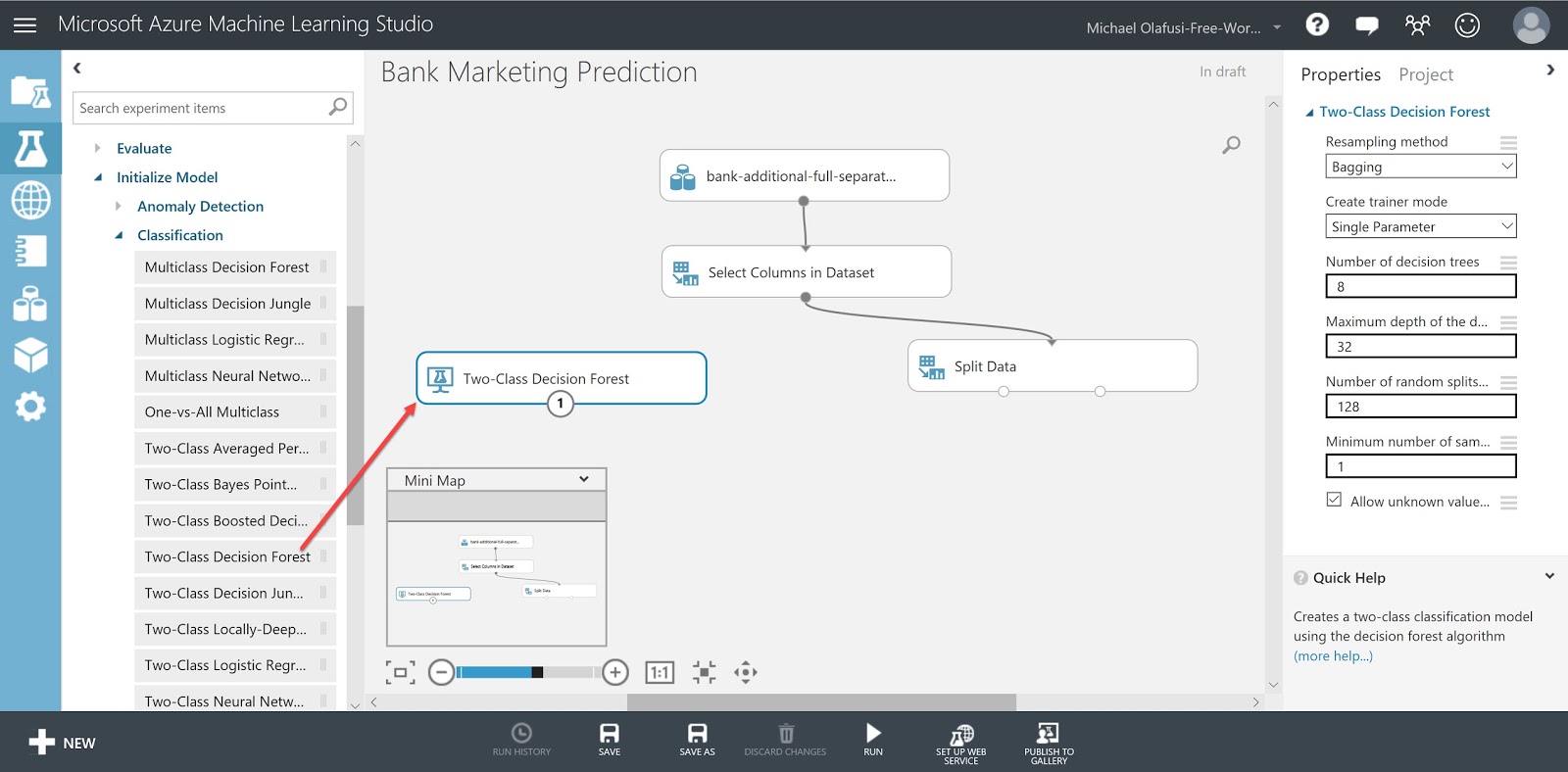
Yesterday, I demoed how in 10 mins you can create a predictive model, deploy it as a web service and test it without having to install anything or pay any money. That is the awesomeness made possible by Microsoft with the super easy to use Azure Machine Learning Studio. The yesterday event was the Lagos edition of the Global Azure Bootcamp held at Microsoft office, Lagos.

Participants were able to follow along, created and deployed their own predictive models too. In today's post I will be guiding you with easy steps to follow on how you too can in a few minutes create and deploy a predictive model cost-free with Azure Machine Learning Studio.

Step 1
Download the sample data we would use: Bank Marketing data from UCI Machine Learning Repository. If you download from UCI Machine Learning Repository directly, then it is the bank-additional-full.csv file in the zip file you end up with. Then you have to make sure that you break the data into separate columns rather than leave them comma separated, using Excel's Text to Columns. For you ease, I have shared a cleaned version you can directly use without any extra work by you: Bank Marketing data download

The sample data is a marketing campaign data of a Portuguese bank from May 2008 to November 2010 recording the details of prospects reached via phone calls and whether they eventually took up the service the bank was trying to sell them.
The cleaned sample data
Below is the explanation of the different fields in the data records.

Input variables:
# bank client data:
1 - age (numeric)
2 - job : type of job (categorical: 'admin.','blue-collar','entrepreneur','housemaid','management','retired','self-employed','services','student','technician','unemployed','unknown')
3 - marital : marital status (categorical: 'divorced','married','single','unknown'; note: 'divorced' means divorced or widowed)
4 - education (categorical: 'basic.4y','basic.6y','basic.9y','high.school','illiterate','professional.course','university.degree','unknown')
5 - default: has credit in default? (categorical: 'no','yes','unknown')
6 - housing: has housing loan? (categorical: 'no','yes','unknown')
7 - loan: has personal loan? (categorical: 'no','yes','unknown')
# related with the last contact of the current campaign:
8 - contact: contact communication type (categorical: 'cellular','telephone') 
9 - month: last contact month of year (categorical: 'jan', 'feb', 'mar', ..., 'nov', 'dec')
10 - day_of_week: last contact day of the week (categorical: 'mon','tue','wed','thu','fri')
11 - duration: last contact duration, in seconds (numeric). Important note: this attribute highly affects the output target (e.g., if duration=0 then y='no'). Yet, the duration is not known before a call is performed. Also, after the end of the call y is obviously known. Thus, this input should only be included for benchmark purposes and should be discarded if the intention is to have a realistic predictive model.
# other attributes:
12 - campaign: number of contacts performed during this campaign and for this client (numeric, includes last contact)
13 - pdays: number of days that passed by after the client was last contacted from a previous campaign (numeric; 999 means client was not previously contacted)
14 - previous: number of contacts performed before this campaign and for this client (numeric)
15 - poutcome: outcome of the previous marketing campaign (categorical: 'failure','nonexistent','success')
# social and economic context attributes
16 - emp.var.rate: employment variation rate - quarterly indicator (numeric)
17 - cons.price.idx: consumer price index - monthly indicator (numeric) 
18 - cons.conf.idx: consumer confidence index - monthly indicator (numeric) 
19 - euribor3m: euribor 3 month rate - daily indicator (numeric)
20 - nr.employed: number of employees - quarterly indicator (numeric)

Output variable (desired target):
21 - y - has the client subscribed a term deposit? (binary: 'yes','no')

Step 2
Sign up for Azure ML studio. It is easy and free: https://studio.azureml.net 


Step 3
Upload the Bank Marketing dataset. From Datasets section on the left menu pane, click New at the bottom left.


Step 4
Create a new experiment. From Experiments section on the left menu pane, click New at the bottom left. Choose a blank experiment, as we are creating ours from scratch.


Step 5
Now we start dragging the tasks we want to carry out into the Experiment workspace, after renaming the Experiment.


Drag in the dataset we uploaded, it is in the Saved Dataset section on the left.


Next, we need to isolate the fields that would be useful for our predictive model. If you look at the description of all the fields in the dataset, it is obvious that some are not practically useful in creating a prediction of whether a prospect will take up the marketed service or not. Example is the length of the call, there is no way you would know that until the end of the call -- so not useful for profiling who to call (targeted marketing). By my thinking, the fields I that would be of real world use in creating an actionable predictive model are -- age, job, marital, education, default, housing, loan.

Drag Select Columns in Dataset in the Manipulation subsection of Data Transformation section. Connect the dataset previously dragged in to the select columns task. Then click on Launch column selector, and select the columns needed (including the outcome we want to predict, so as to be able to train the model).


Next, split the data into training set and testing set for building our predictive model. Drag Split Data, connect to the select columns task and on the settings pane on the right, set the training set to 0.75 (75%) of the entire dataset.


Drag in the model algorithm to use. It's under the Initialize Model. I chose to use the Two-Class Decision Forest. In the end, you would evaluate the model to see if it fits well or you should try another algorithm.


Drag in Train Model. Connect to both the already dragged in algorithm and the left side of the Split Data (training set). Select the outcome to predict.


Drag in Score Model. Connect to the Train Model and the testing set of the Split Data.


Lastly, drag in Evaluate Model. Connect to Score Model.


Now run the entire experiment.


Wait for it to finish running.


Right click on Evaluate Model and visualize the evaluation result to see the fitness/accuracy of the algorithm.


If you are okay with the fit, then what's left is to publish. Otherwise, you can change the algorithm, re-run and re-evaluate the fit.


Step 6
Now you set up the model as a web service that can be deployed online.


Change the input connector to point to the Score Model. 


Also, remove the predicted column from the Selected Column as it was only needed for training the model.


Now re-run and deploy as web service.


You are presented with the web service details to use for integrating with any app or online tool. You can even test the API directly.


And that's how you create and deploy a predictive model in Azure Machine Learning Studio without installing anything on your computer and without paying a cent/kobo.

Enjoy!
Creating my Nigerian Market Data app (stocks, economic and fx rates app) involved setting up an Azure VM that I run a couple of Python scripts on daily. 


I used Windows Task Scheduler to automate the Python scripts to run between 9:20 pm and 11:00 pm. It wouldn't make sense to keep the server (Azure VM) running all day. So I set up an automation on Azure to start up the server at 9:00 pm and shut it down by midnight. Below are the steps to doing this.

If you run a search online, you will come across multiple ways to doing this. Some require you writing Powershell scripts. The method I am going to illustrate is the least error prone and most straightforward way I have come across.

Step 1: Log into your Azure account portal


Click on Create a resource.

Step 2: Search for Automation


Click on Automation.

Step 3: Create a new Automation


Step 4: Complete the Automation Account Creation
Make sure to tick use existing resource group, and pick the resource group of the VM you want to auto shutdown/startup. Also best to match the location selection.


Step 5: Add Startup and Shutdown Runbooks to the Automation Account
Select the automation account you just created.


Select Runbook under Process Automation. And click on Browse gallery. This allows you to create the startup and shutdown automation runbooks.


Click on Edit in the created Runbook


Then publish the runbook.


Click on Schedule after publishing.


Set the Time to run the Start VM runbook by clicking on "Link a Schedule to your runbook"


Lastly, set the parameters which will link it to the VM you want to control. Make sure you match the resource group and VM name. You can leave the AzureConnectionAssetName blank so the default is used.


Now you repeat same steps for Shutdown runbook after picking from the runbook gallery.


Step 6: Sit back and watch the automation runbooks do their work

You can monitor the runbook activities from Jobs in the Runbook Overview.


And that's all!


As a full-time Microsoft Excel consultant, of all the over 450 formulas in Excel there are just a handful I focus on in my training classes because they provide the most value in practical day-to-day use of Excel. If you examine any reports or templates (even the most complex one you've ever come across), you will see that the these formulas are the ones powering those reports.

In this webinar, I will be taking you through those formulas in my usual very practical way and provide you with the practice file for your own use later on.

The formulas are:
1. VLOOKUP
2. HLOOKUP
3. LOOKUP
4. INDEX & MATCH
5. IF
6. SUM
7. COUNTIF
8. SUMIF
9. SUMPRODUCT
10. ROUND
11. CEILING
12. CONCATENATE
13. LEFT
14. RIGHT
15. MID
16. TODAY
17. DAY
18. MONTH
19. YEAR
20. UPPER
21. LOWER
22. PROPER
23. RAND
24. RANDBETWEEN
25. INDIRECT

As usual, the webinar will be live on YouTube and the recording made available instantly after the webinar.

You can join in:
Time: 3:00pm (GMT +1)
Date: 28 March 2018
Venue: YouTube Live (https://www.youtube.com/watch?v=3KxWVqqV6ZA)

See you!

To be in loop of all our future webinars, then sign up to our Webinar Directory (http://eepurl.com/bKwoaT)
Ever suspected someone has changed your file or report in Excel or edited places you didn't want them touching? Or it is that you have two different files that should have some similarities and you want to know where the difference lie.

If you use Excel 2013 or Excel 2016 professional plus, then you should start celebrating. Microsoft has included a very helpful tool called Inquire that does that comparison of files for you on any level of detail you want. 

Below is an illustration of me using it to compare two different version of same loan repayment computation file. See how easy it is to use. (You'll first have to enable it, then use).


Cheers!
image: ejbastes.com

Last week, I was hired as a facilitator for a one week "Excel for Business" training for NNPC senior (looking) staff. While teaching them the financial calculations formulas in Excel, I told them I was going to show them the magic of compound interest. That if I started saving N12,000 monthly in a 15% annual interest rate account from the age of 20 and another person started saving N100,000 monthly in a 15% annual interest rate account from the age of 40, and we both retire at the age of 60; I am going end up with more money that the other person. I wished you were there to see the serious look of disbelief on their faces. 


We did the calculation and not only would I have more money but my money would be more than double that of the other person. I told them that's the magic of compound interest -- when your interest earns interest for you. Then I told them knowing this permanently changed my life -- especially my lifestyle and my friends. It is the basis for my preferred way to building wealth.

We all know that the secret to financial happiness is spending less than you earn, but what many of us underestimate is the innate desire we have to spend. The brain is an expert at justifying spending. And without superior arguments that knowledge of the magic of compound interest provides, you will seldom win the battle to not spend.

I know too many people who are not terrible with their finances but because they don't understand the magic of compound interest in achieving wealth, they only save for a long time to spend all on something big. So theirs is more of delayed spending, rather than saving to build wealth. 

I save/invest to build a passive income that can fund my expenses and any wild adventures, without dipping into my original capital. That sounds too theoretical. So here's something more practical sounding -- Jim Ovia will be getting a dividend of N12 billion as a shareholder in Zenith Bank this year. Even if he buys a private island or squanders all that money, his original investment is intact, growing and will generate even more of such money for him in coming years. All you needed to be getting that type of benefit was to have invested couple of millions of Naira in Zenith Bank shares about two decades ago. You didn't need to have started the bank or play any active role in it. That is the magic of compounded growth (which is the foundation of every proper investing/saving).

For the past four years Microsoft has been inviting me for fully sponsored events in USA, Dubai, Turkey, Netherlands, South Africa and a few other places. All required from me was to pay my flight (and visa). It was only the first year, I made efforts to go. Now I think of what that $2,500 I will spend on flight and comfort will be within just a few years of compound interest magic. So I don't go. The one that held this month in USA, all the other MVPs (Microsoft Most Valuable Professionals) in Nigeria went and said people asked about me (the missing guy). That is how seriously I take this saving/investing thing. I have become a miser. I have no qualms spending on my business or ideas that will generate income. Just last month, I bought a N560,000 laptop. The dollar funds I wouldn't dip my hand into for flight to USA, I speedily withdrew from when I wanted to build my stock analysis app. I spent about N1.5 million on tax matters (N700,000 for VAT and N800,000 for auditing) last year (to a government that mostly squanders the money). That alone is enough reason to want to spend something on oneself. But when I think of the magic of compound interest, I would rather save/invest.

My recommended path to achieving wealth is saving or investing in a high yield account/instrument. 

One of the people in the NNPC class remarked that life is too short and I would miss out from the opportunities those events open up. Those are sacrifices I am willing to take. By the way, when you die whether you've visited all the countries in the world or never seen beyond your corner of the earth, will not matter. And as regards opportunities my miserly lifestyle will deny me, I don't care. I get too many opportunities I pass on already. Plus, in my line of work there will always be a client willing to fund my traveling as part of the consulting work to be done for them (so they cover my travel, hotel, feeding and still pay me for my time + expertise).

Ultimately, my advice to you if you are an average Nigerian like me and young, is that think about the many startups that start gloriously and fold up later. Then think about your Instagram friends and Facebook friends who are starting life on the fast lane. Wealth is not about what you spend but what you have after spending. And with compound interest, better to delay your spending as far into the future as you can. 

image: economist.com
Except you are very familiar with the following Bible passage, "So then because thou art lukewarm, and neither cold nor hot, I will spue thee out of my mouth." (Rev 3:16), then you might not fully understand how much I avoid lukewarm water. My distaste for lukewarm water ended up making me take more of soft drinks. There is just something uninviting about that taste of room temperature water. And when I am ill, I totally just want to avoid it. It is like a punishment for me to take drugs with room temperature water.

It is not really that I like Coke (Coca-Cola) or Pepsi or any of the other drinks I end up buying and drinking, the real problem is that I dislike lukewarm water. While in university when you remember to drink water only after you are almost dying from thirst and can't afford Coke or any of them bottled drink, it was not a big problem. I drank mostly cold sachet water. But as I got out of university and started earning money and could afford them fizzy drinks, it became a daily affair. I would down my lunch food with a bottle of Pepsi or Coke every workday. 

Then I became more health conscious, and don't laugh at this: my bright healthy idea was to limit my soft drink intake to one 50cl bottle a day. And it didn't always work out that way -- some days I would down more than one bottle and other days I would deliberately go out of my way to buy a bottle of Coke or Pepsi when it's almost end of day and it's looking like I might end up not drinking any that day.

After a couple of months/years, it occurred to me to go zero sugar. To buy Pepsi Light or Coke Zero or Sans Creme Soda or any other low/zero sugar drink. I felt proud of myself. And would buy them in bulk amount so I don't have to hunt around for them. Well, recently I found out that it's another terrible idea.

I did a thorough reading online -- reading through research papers and health articles on health safety of zero sugar drinks. They are no good. The sugar substitutes used to make them sweet without adding calories confuses the body system and interferes with the proper functioning of the body (in a small way but still worth paying good attention to). You drink them and your body thinks food has come, and your taste buds and digestive system and food hormones believe its the natural sugar but encounters something they are not configured to handle. It totally disrupts their response and creates other types of problems you don't want.

So what is the healthy alternative to soft drinks? Well, the answer is and has always been water. And if you are like me, maybe cold or hot water. Now I am doing the right healthy choice. I make it my goal to drink only water. I will fail at it, but will be happy with a 70% success rate.

I'm back again. 

Hope you missed me.

If you do a lot of online transactions like me -- buy stuffs on Amazon, pay for online web hosting, buy domains from Godaddy, watch Netflix, pay for Google advertising, pay for business tools in dollars and doing an online MBA with a foreign university -- then you should ditch GTBank, FCMB, Zenith Bank and every other bank that charges you more than N362/$. You should get an Ecobank Naira MasterCard and start enjoying lower than mallam rates. GTBank bills me at over N367/$ and FCMB does about N380/$.

See screenshots below:

GTBank charged N7,344.61 for $20, rate was N367.23/$

FCMB charged N5,704.12 for $15, rate was N380.27/$

Ecobank charged N5,430.00 for $15, rate was N362/$

When I discovered this last month, I even stopped funding my dollar account from mallams at N364/$ and started using Ecobank Naira Mastercard for all my foreign denominated online transactions. I immediately removed the other cards from my Amazon account, Paypal account, Netflix account, Quickbooks account, Microsoft Azure account, ExpressVPN account and every other accounts that charge me in dollars. Most importantly, it improved my margin on my US iTunes gift card sales site (before with the GTBank rate I was not making profits, then I switched to sourcing dollars from mallam to fund my Dollar card at N364/$). Now I am less stressed and happier with Ecobank rates.

And that's my useful tip for you today. I have many other things to share since the last post I made. A lot has happened and I am not sure which to keep to myself and which to share. See you again tomorrow!


It is today, at 3:00pm Nigerian time. Joining link is https://www.youtube.com/watch?v=mJNHmMf3nNw And if you won't be able make the live webinar, you will can access the recording on YouTube via https://www.youtube.com/watch?v=mJNHmMf3nNw

I have been teaching professionals from different companies and countries Power BI since 2015.

Many people still find it tough to grasp what the value is in using Power BI or what business intelligence really is. Some even see it as one of those shinny new tools that line consultants pockets with money but provide not much tangible value for the company.

In this webinar, I will attempt to condense my two days class into a 45 mins one focusing more on helping you understand the value of business intelligence and how Power BI works in creating value beyond what is possible with Microsoft Excel.

So make it a day with us and you'll be on your way to grasping the practical use of business intelligence via Power BI.

Date: Wednesday, 28th February 2018
Time: 3:00pm -- 4:00pm (Nigerian time)
Venue: YouTube live (https://www.youtube.com/watch?v=mJNHmMf3nNw)

See you!


I have been teaching professionals from different companies and countries Power BI since 2015.

Many people still find it tough to grasp what the value is in using Power BI or what business intelligence really is. Some even see it as one of those shinny new tools that line consultants pockets with money but provide not much tangible value for the company.

In this webinar, I will attempt to condense my two days class into a 45 mins one focusing more on helping you understand the value of business intelligence and how Power BI works in creating value beyond what is possible with Microsoft Excel.

So make it a day with us and you'll be on your way to grasping the practical use of business intelligence via Power BI.

Date: Wednesday, 28th February 2018
Time: 3:00pm -- 4:00pm (Nigerian time)
Venue: YouTube live (https://www.youtube.com/watch?v=mJNHmMf3nNw)

See you!

image: creditdonkey.com

You can read more from the author, Kenneth Doghudje, at https://moneytalkng.com

Wealth, riches and financial success is the result of teamwork. It is usually the product of several parties coming together with a common objective, and working systematically towards its attainment. In other words becoming wealthy is the culmination of various contributions from a number of people.

It is a misnomer to use the term “self-made” to describe any of the nearly two thousand billionaires (in dollars) on the planet today. No one is self-made; we are all products of influences. Billionaires didn’t just fall into wealth, they were trained, mentored, assisted, empowered, encouraged and motivated to attain financial heights. They were given a helping hand at some point or the other as they climbed up the financial ladder.

Just as the old saying goes, “behind every successful man there is a woman” I boldly declare to you today that, “behind every rich man there is a team.” I call it, “the money team,” a term borrowed from Floyd Mayweather Jnr., the highest paid athlete in the world of professional sport. In order to build wealth you will need to cultivate your own money team, comprising individuals with the required skill sets to build wealth. 

So who are those characters that make up a successful money team? 

The first player on your money team is a lawyer who is well versed in business matters. Controlling great wealth and fortune always involves contracts and agreements because these documents are the vehicles used in closing big deals.  They contain terms and conditions which must be thoroughly vetted by an adviser who has your interests at heart before you sign them. No one is going to do big business without a signed agreement so your lawyer is there to advise you so that you don’t lose money or embark on unprofitable ventures. Make sure your lawyer thoroughly vets any documents before you sign them. You would be wise to listen to their advice before deciding to act.

No money team can be complete and fully empowered to create wealth without a banker. You will need other people’s money at some stage in your financial life if you want to attain major financial success. It is unlikely that you will have all the capital needed to finance large business opportunities so having a banker on the team comes handy to get loans at the best rates. Many times the bankers push to get loan facilities for their clients because they believe in what they are doing. You can’t afford to distrust bankers if you are serious about building wealth. Embrace them instead.

You need to engage the services of an accountant as part of your money team. The accountant will take care of the books, thereby giving your business a semblance of order and professionalism which will resonate with anyone that wants to give you big deals or help you access substantial business opportunities. Such big players always ask for financial statements of performance and compliance with regulatory requirements such as tax matters etc. An accountant is a must have.

Fourth no money team is complete without a cheerleader. When the challenges and storms associated with building wealth knock on your door there had better be someone around to cheer you up. Your cheerleader could be your spouse, family member or anyone who believes in you. There will be times you want to give up, this person is there to keep urging you on to achieve your goals. You need a cheerleader in your corner to keep you motivated.

Building wealth is not rocket science, it is actually the product of applying laws. It is imperative you work with someone who can coach or mentor you towards its acquisition. Your money team must include a teacher or mentor. Now this is equally important as he or she has succeeded in doing what you are trying to do. Your mentor has the requisite knowledge, experience and expertise to aid you on the path to your success. A mentor will shorten the time it takes to achieve success as you will receive advice that will help you avoid unnecessary delays or pitfalls. Your mentor may not be readily accessible but you can gain from the wealth of knowledge by reading books and studying other materials they have written.

Sixth, you need spiritual advice to keep you grounded as there is a tendency to go overboard when trying to build a fortune. Many people on this quest have ended up destroying themselves. A spiritual adviser is there to help you keep everything in proper perspective. Money is important, but it is not everything there is to life.

There is also the need to effectively make use of the gains and incomes earned so the services of an investment adviser is required as part of your money team. Now there are several investment vehicles to choose from when you want to invest your resources, your investment adviser comes in handy to assist you in drawing up an investment plan and sticking to it.

Finally your money team would be incomplete without an assistant, a support staff whose role is to assist in the execution of plans and strategies. Building great wealth requires a lot of activities being undertaken, all at the same time that it might be too much for only you to handle. This is where another person can help so that more things can get done much faster.


Building wealth requires great effort and knowledge which is impossible to be undertaken by one individual. In most cases he or she will need the help of others. In my study of the lives of several billionaires I discovered they all have a team of people working behind the scenes, and assisting them to amass wealth, and in the process becoming wealthy themselves. Serious wealth cannot be built by one person alone. So start now to put together your money team. You will be utilizing one of the strategies of the financially successful when you do so.


Author's Profile:
Kenneth Doghudje is intensely committed to seeing people achieve their financial goals and aspirations in Africa. A CEO by day and a blogger by night, he believes that the secret to anyone succeeding financially is to mix workable insights with action which translates to wealth and riches.

Please endeavor to visit www.moneytalkNG.com for more articles on money and personal finance. You can also follow Kenneth on social media: @moneytalkNG on twitter, moneytalkNG on Facebook & Instagram